
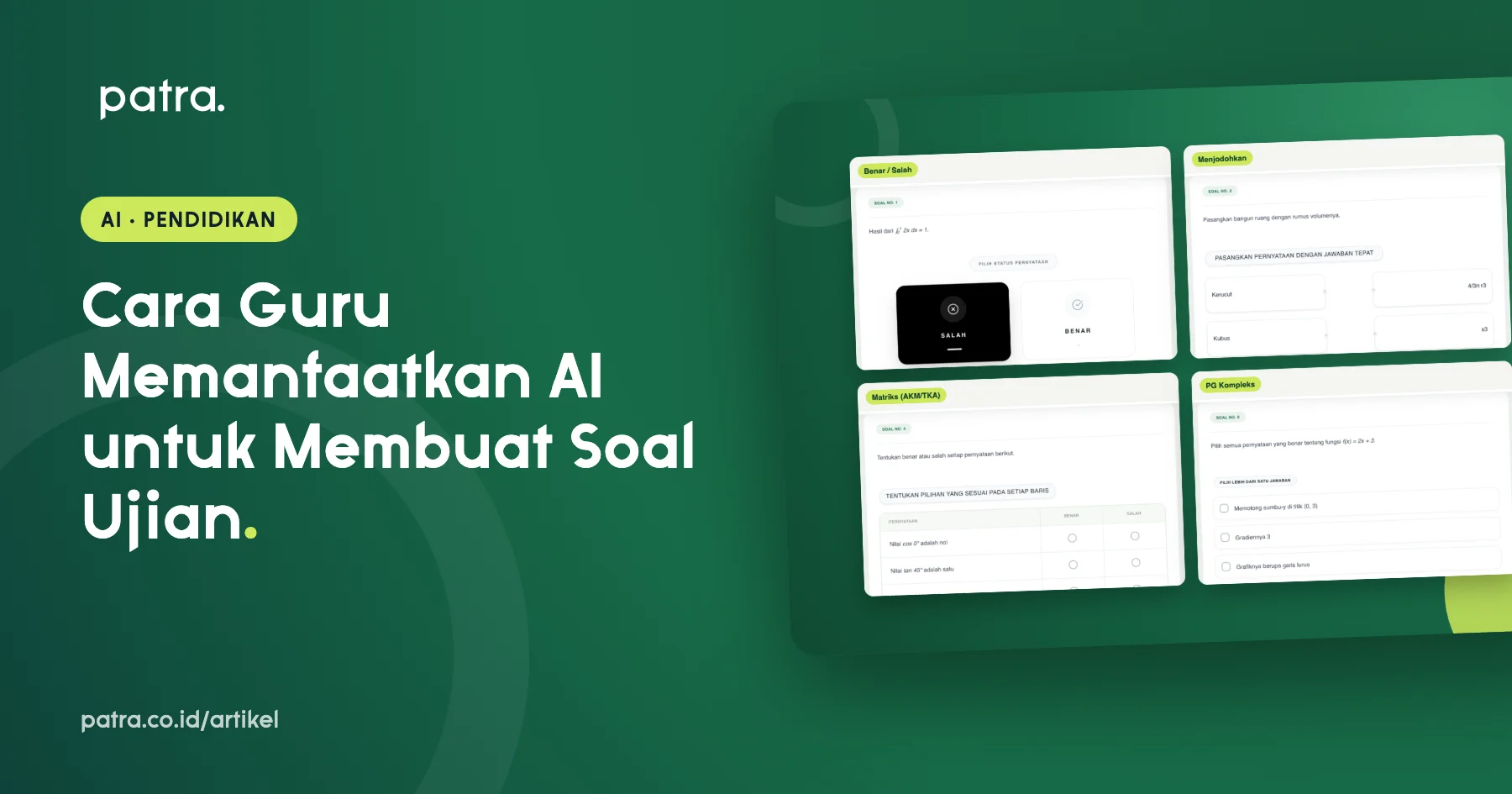
How Teachers Can Use AI to Create High-Quality Exam Questions
A practical guide to using AI for writing exam questions, from crafting the right prompt to reviewing quality before use.
Writing exam questions is one of the most time-consuming parts of a teacher's job. A good question set needs a blueprint, a range of difficulty levels, plausible distractors, and a correct answer key. Artificial intelligence (AI) can now cut that time dramatically, as long as it is used the right way.
AI as an assistant, not a replacement for teachers
Generative AI such as ChatGPT, Gemini, or Claude is excellent at producing drafts. But teachers still play the leading role: setting learning objectives, checking content accuracy, and adapting the language to students' abilities. Think of AI as a fast-writing colleague, while you are the editor who decides the final quality.
5 steps to creating questions with AI
- Start with a blueprint. Write down the competencies, topics, cognitive levels (for example C2–C4), and the number of questions you need.
- Provide clear context. Specify the grade level, curriculum, and question type: multiple choice, complex multiple choice, true-false, matching, or essay.
- Upload source material. Questions generated from your own lesson summaries are far more relevant than generic questions from the internet.
- Ask for explanations. Besides the answer key, ask the AI to explain the reasoning behind each answer. This makes it easier to verify correctness.
- Review and revise. Check facts, numbers, and spelling, and make sure distractors are not ambiguous.
An example of an effective prompt
"Create 5 multiple-choice questions for grade 11 on the circulatory system, cognitive level C3, each with 5 options and one correct answer. Include the answer key and a brief explanation. Use formal English."
TKA and AKM-style questions
TKA (Tes Kemampuan Akademik, Indonesia's Academic Ability Test) and AKM (Indonesia's Minimum Competency Assessment) rely heavily on stimuli or reading passages followed by several questions. AI is a great help in creating stimuli such as short reading texts, data tables, or case studies, then turning them into complex multiple-choice items and true-false matrices. Practicing with the same format helps students feel more prepared on exam day.
What to watch out for
- Hallucinations: AI can state incorrect facts very convincingly. Always verify.
- Questions that are too easy to guess: weak distractors make questions lose their discriminating power.
- Confidentiality: never enter students' personal data into public AI services.
From draft to exam in a single app
In Exampatra, teachers can generate questions with an AI generator directly from uploaded material, save them to a question bank, and use them for computer-based exams. After the exam, item analysis shows which questions were too difficult or failed to discriminate between students, so question quality keeps improving over time.
With the right workflow, AI is not a threat to teachers but a way to free up more time for what matters most: guiding students as they learn.